

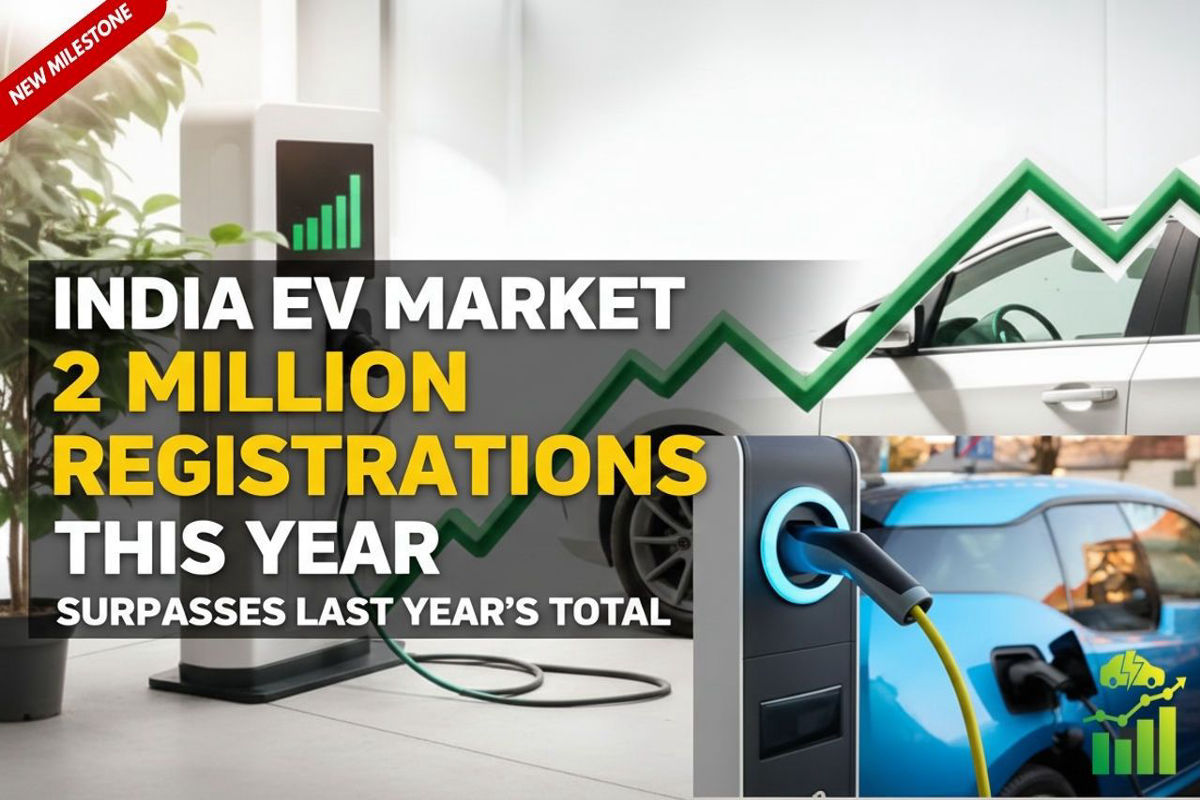
India EV market has crossed a significant threshold in 2025, with total registrations exceeding 2 million units. This landmark achievement reflects growing consumer interest, expanding EV model choices, and strengthening policy support to boost clean mobility.
India EV Market Breaks New Ground in 2025
In 2025, India electric vehicle market reached a historic milestone by registering over 2.02 million pure electric vehiclesNsurpassing the entire 2024 figure of 1.95 million even with more than a month still remaining in the year. This growth highlights a strong shift towards clean, sustainable mobility powered by rising consumer demand and improved availability of EV models across categories.
The surge in registrations stems from a growing awareness of climate change impacts, government incentives, and the availability of affordable and efficient electric vehicles.
Electric Two-Wheelers Lead the Charge
The electric two-wheeler (E2W) segment continues to dominate the Indian EV market, with 1.2 million units sold in 2025 so far. This surpasses the 1.15 million units recorded in the entire previous year, reflecting its affordability and suitability for urban commuting in India congested cities.
Growth in Passenger Vehicles and Three-Wheelers
Electric passenger vehicles, including cars and SUVs, have experienced a notable 57% increase in registrations, with 156,455 units sold in 2025 compared to 99,429 in 2024. This surge is driven in part by new model launches, increasing range, and growing consumer trust in electric cars.
On the other hand, electric three-wheelers have registered steady sales numbers, with around 690,000 units sold, almost on par with 6.91 lakh units in 2024. This category remains key for last-mile connectivity and goods transport.
Industry Outlook Predicts Steady Growth
According to Poonam Upadhyay, Director at Crisil Ratings, the EV market in India is expected to grow at a healthy mid-teen rate in 2025. While this growth is slower than the previous years 27% jump, it remains robust, supported by firm demand for two-wheelers, ongoing electrification of three-wheeler fleets, and an expanding pipeline of new electric four-wheelers.
Established original equipment manufacturers (OEMs) have been critical in driving electric two-wheeler demand through wide dealer networks, competitive pricing, and models with higher range. This has boosted retail confidence despite some policy changes affecting subsidies and incentives.
Charging Infrastructure and Consumer Confidence
One of the major factors fueling EV adoption is increased consumer confidence in charging infrastructure. While long-distance travel still presents challenges, urban users can generally rely on accessible home and workplace charging, making EV ownership practical and convenient. The ongoing expansion of public charging stations and improvements in battery range continue to address earlier concerns about “range anxiety.”
Automakers Invest Heavily in Production and Innovation
Legacy carmakers in India who once thrived on petrol and diesel vehicles are now aggressively investing in the electric future:
-
Maruti Suzuki has entered the EV space with its e-Vitara and plans to export 50,000 to 100,000 units annually.
-
Tata Motors leads the market by expanding its electric SUV and hatchback lineup while increasing production capacity and investing in advanced battery technology.
-
Hyundai Motor India focuses on building a robust charging infrastructure alongside localizing components and launching new EV models.
-
MG Motor India is scaling up electric SUV production and collaborating with local component manufacturers to reduce costs.
-
BYD is expanding beyond metro cities to attract a wider customer base for its electric vehicles.
-
Tesla and VinFast represent growing international interest, both having launched electric cars in India to cater to premium and mass-market segments.
What This Means for India EV Future
India crossing of 2 million EV registrations is a defining moment in its clean mobility journey. The market expansion signifies strong public acceptance and will likely encourage further investments in manufacturing, technology, and infrastructure.
This milestone aligns with India climate commitments, reducing pollution and dependence on fossil fuels while creating jobs and technological innovation. With increasing competition among automakers and stronger policy frameworks, India is poised for continued growth in electric vehicles, transforming urban mobility and contributing to environmental sustainability.